Christopher Horace Steele-Perkins (born 28 July 1947) is a British photographer and member of Magnum Photos, best known for his depiction of Africa, Afghanistan, England, and Japan.
Steele-Perkins joined Magnum Photos in 1979 and soon began working extensively in the developing world, in particular in Africa, Central America and Lebanon, as well as continuing to take photographs in Britain, but after marrying his second wife, Miyako Yamada, he embarked on a long-term photographic exploration of Japan and one of his photo essays is the: JAPAN. Aftermath of the Tsunami.
VIDEOS
Tsunami Streetwalk 1, Kesennuma


Tsunami Streetwalk 2, Kamaishi
Tsunami Streetwalk 1, Kesennuma and Tsunami Streetwalk 2, Kamaishi can both be viewed in the essays section of the Magnum Inmotion site (hyperlinked)
These works/projects are very simple in concept. Kesennuma and Kamaishi are two of the many Japanese coastal cities that were devasted by the 2011 Tsunami.
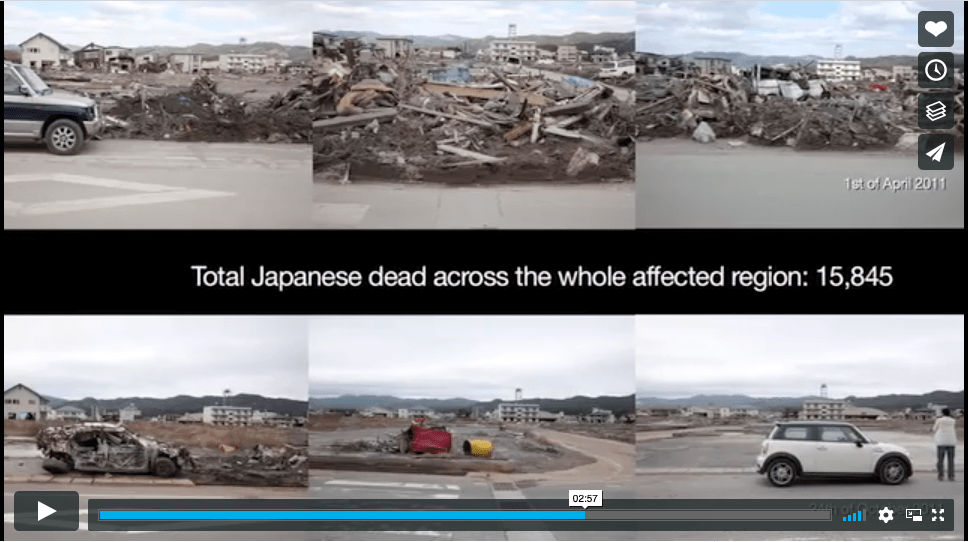
For Streetwalk 1 Steele Perkins visited Kesennuma 23 days after the disaster and took the approach of selecting a single – quite ordinary road, Nainowaki Street, where he took photos of the remains of the properties every 20 paces.
He returned to the same road seven months later and took exactly the same photographs. For each visit he has joined the photos together into a rolling strip and placed the later set beneath the initial set so the properties perfectly align and we can see the direct comparisons.
The message of his work is pretty simple – there was unimaginable destruction in this city and seven months after the event there has been no re-building, the place is still devastated, it is just a little neater with some of the debris removed. A long road has been flattened, every home and business has gone but by bringing time, an essential aspect of narrative, into the presentation he also shows that the scale of the damage was so great that, after seven months, only minimal progress has been made.
There is a rolling captions in the video, to add information about the details of basic statistics. Also, the sequence of photos is supported by hauntingly beautiful Japanese flute music.
The artists opens this presentation by asking “How can you convey the scale of destruction visited upon japan by the earthquake and tsunami that hit Japan on March 11th 2011?”
What follows has a sense of being a diary, the photographer very directly involves himself in the narrative by saying “I walked down Nainowaki Street ……..” he is intentionally connecting us to the event through his eyes. “a wasteland of shattered homes and businesses and damaged lives.”
The use of text in this presentation is very effective as it ensures the viewer understands the context. He remains “silent” for nearly half the rolling presentation to allow the visual messages to sink in before starting to provide the statistics (facts).
The story ends by telling us that it is estimated that it will take ten years for the city to return to normal.
The treatment of the other city, Kamaishi, is much the same.
 Professional Practice Blog