When applying for a job, making a strong impression is a huge challenge, but it can make all the difference. Creating a curriculum that stands out from the crowd is one of the best ways to improve your opportunities for employment. The purpose of this document is to tell employers everything they need to know about their qualifications, skills and working history in a concise and elegant package. Many employers value more than almost any other aspect of the information collected from a CV.
Before, I only knew how to make traditional CV’s not until after our creative CV’s for artists workshop in Uni.
I only have a traditional CV, but before making an artist CV, I had to look up some inspiration from other creatives on how they make their CV’s and stand out from the rest.
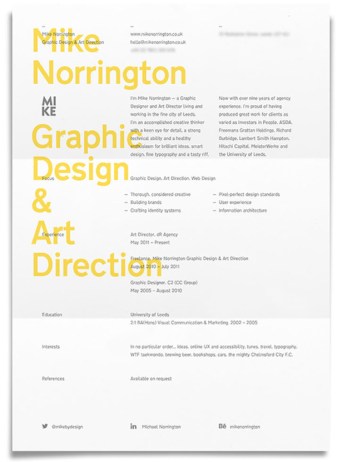
1.) Some may argue it’s not creative at all. But I found it creatively minimal. I love the “MIKE” letter layout and the large, yellow title font on the background. His social media along the page’s footer stands out strikingly well compared to other resumes that just put all contact information in the header or footer.
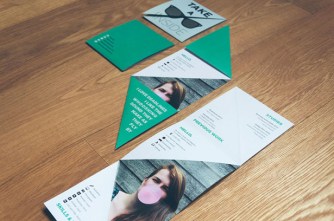
2.) The size and fold of this CV is fantastically creative, and this artist does an excellent job of creating such intriguing CV and really putting into consideration on how you would open it – it leads to the next page. I like it very much because it’s definitely unique.
3.) This artist’s CV design adheres very well to the look of her brand. The whole design is clean and organized, easy to navigate. However, it still looks pretty and shows her abilities in graphic design. She mentioned everything in a humble manner and you can extend the CV to the bottom.
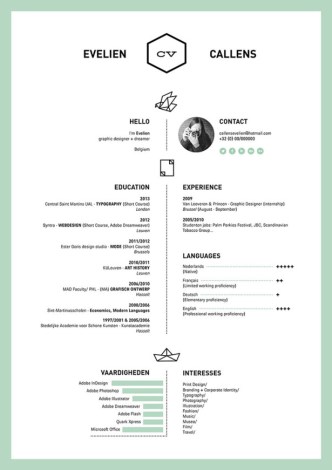
4.) I love how this creative CV organises so much content to one page. It’s almost overwhelming at first glance, however, lines and other graphics can easily draw your eyes from section to section. It shouldn’t take very long for the viewer to go through so that every section and detail is connected to the next and everything should be shown in an expressive and creative way. If I were to make my own creative CV, this is the look that I want it to have.
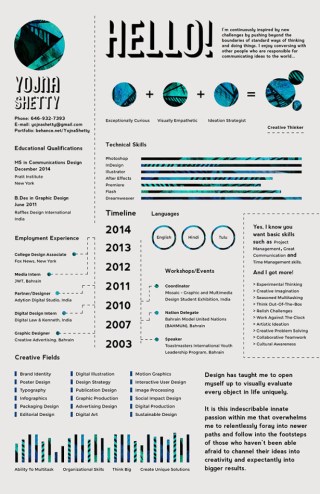
Non-traditional resumes aren’t for everyone. They can, however, be very beneficial for certain types of job applicants. Non-traditional resumes are ideal for job seekers in creative industries like marketing and design. Specifically, online resumes are helpful for applicants wishing to post films, sound clips, photographs, or other work related to their industry.
But according to a study by The Creative Group reports that 70% of employers preferred traditional resumes (PDF/Word) even for creative jobs. Only 20% were interested in infographics, and fewer preferred a social or online profile (4%) or a video resume (2%).
Hence I personally prefer to have both kinds of CV.
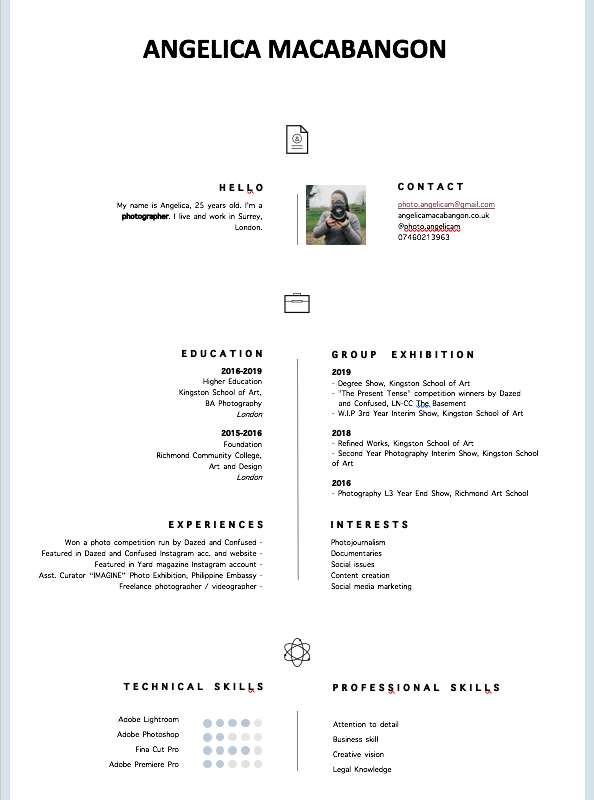
Here is my Traditional CV and my creative CV.


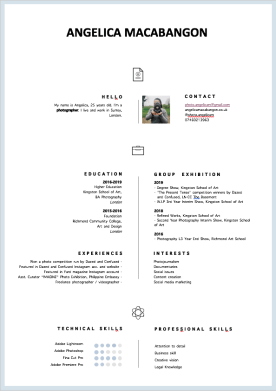
Nontraditional resumes are also helpful for people without an extensive work history. They allow candidates to emphasize skills rather than their chronological work history.
RECAP | DIFFERENCE BETWEEN A CREATIVE CV AND A TRADITIONAL CV
TRADITIONAL CV
-Chronological order
-A bit more loaded with information
-Little to no colour or design
CREATIVE CV
-Visual communication
-Colours, graphics, logo, photo
-Clean, easy to read
I’d also like to mention that in creating a CREATIVE/ARTIST CV for Photographers, it is important to include:
1.)Statement- A short one. Briefly state what your practice is all about.
2.) Include commissions work, exhibition experiences, projects and other relevant stuff
3.) Mention your education.
The important thing that I had to bear in mind when I created my artist CV is to make it relevant to my industry. Also, I can be creative as much as I want. However, for my traditional CV, I’d stick clean layouts and simple designs.
https://www.visualcv.com/examples/photography/
https://www.myperfectresume.com/how-to/cv-examples/photographer-cv-example
 Professional Practice Blog